Booking choice: The private Poás tour, from $183 per person. Check dates Tour details
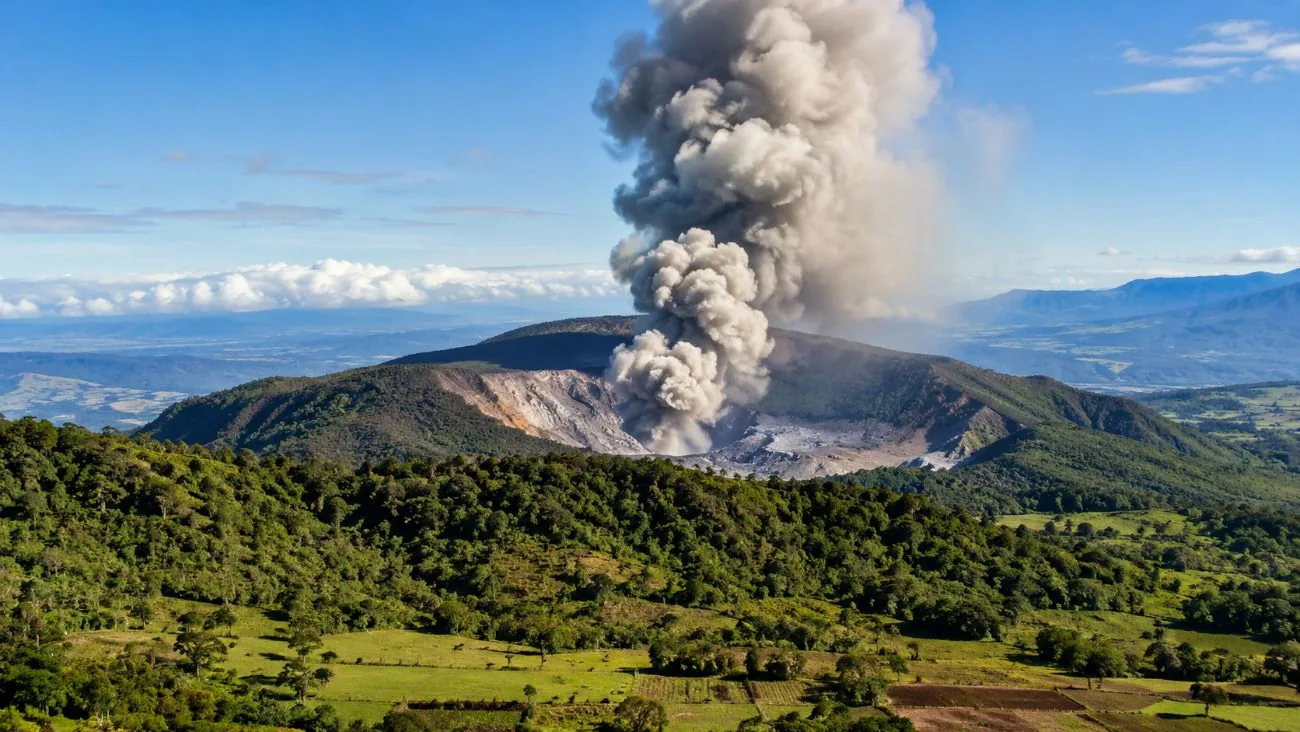
Some tour listings still say Poás "last erupted in 2017". It didn't stop there. Poás erupted through much of 2024, closed for four months in 2025 and erupted several more times in 2026, including on 27 August, which is why visitors now wear helmets at the rim.
None of this produces flowing lava. What Poás does is phreatic eruptions: water in the crater flashes to steam and throws out mud, rock, ash and gas. Here is the record, and how to read the official levels.
The quick answer
Poás is an active stratovolcano with about 40 recorded eruptions since 1828, and in recent years small eruptions have come every few weeks. In 2025 the park closed on 26 March, ash rose more than 4 km on 21 April, the CNE declared a red alert, and the park reopened on 30 July. In 2026 there were eruptions in April, July and on 27 August. OVSICORI kept Poás at level 2 of 4 (Advertencia) through 2026.
Is Poás Volcano still active?
Yes, very. Poás erupted in 2024, 2025 and 2026, and OVSICORI has held it at level 2 of 4, Advertencia, through 2026.
In August 2025 OVSICORI said the volcano "sigue activo con la emisión constante de gases, vapor de agua, aerosoles y un elevado flujo de calor", still active, with constant gas, steam and high heat flow, and that magma sat only a few metres below the main vent (Teletica). That is why the crater glowed at night that year.
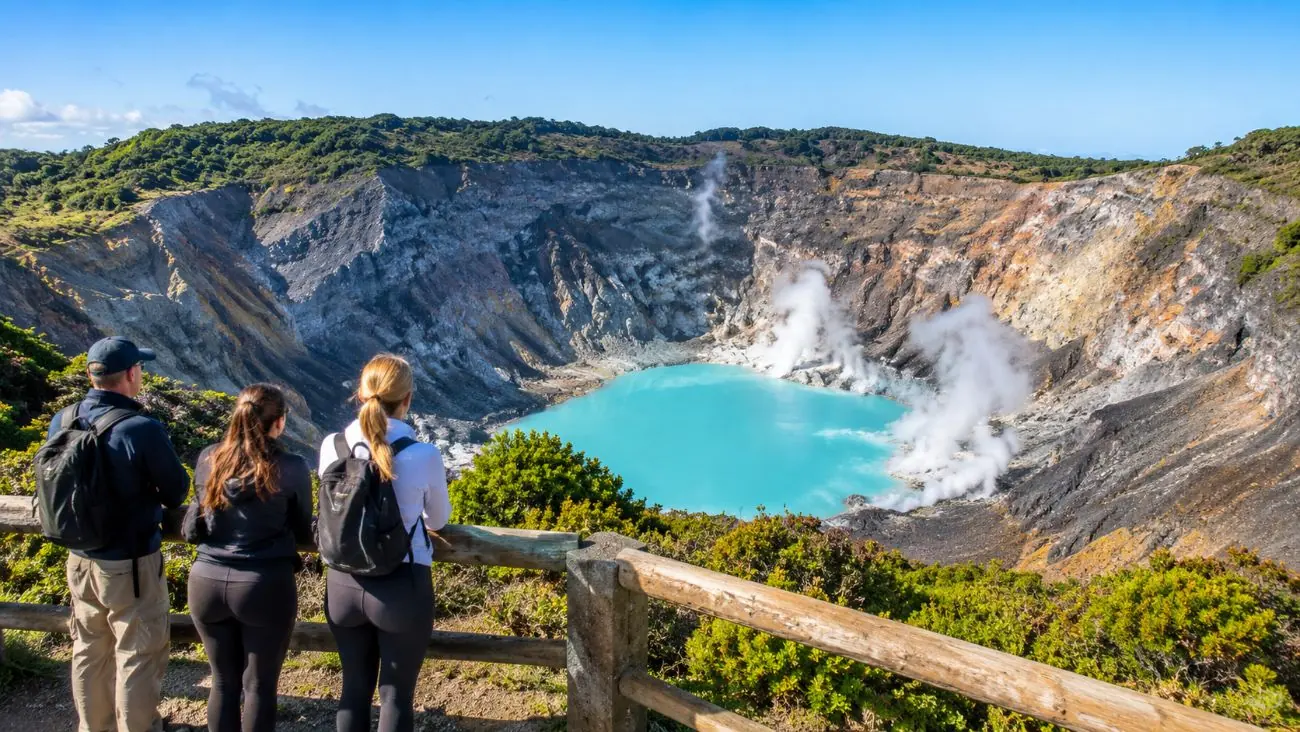
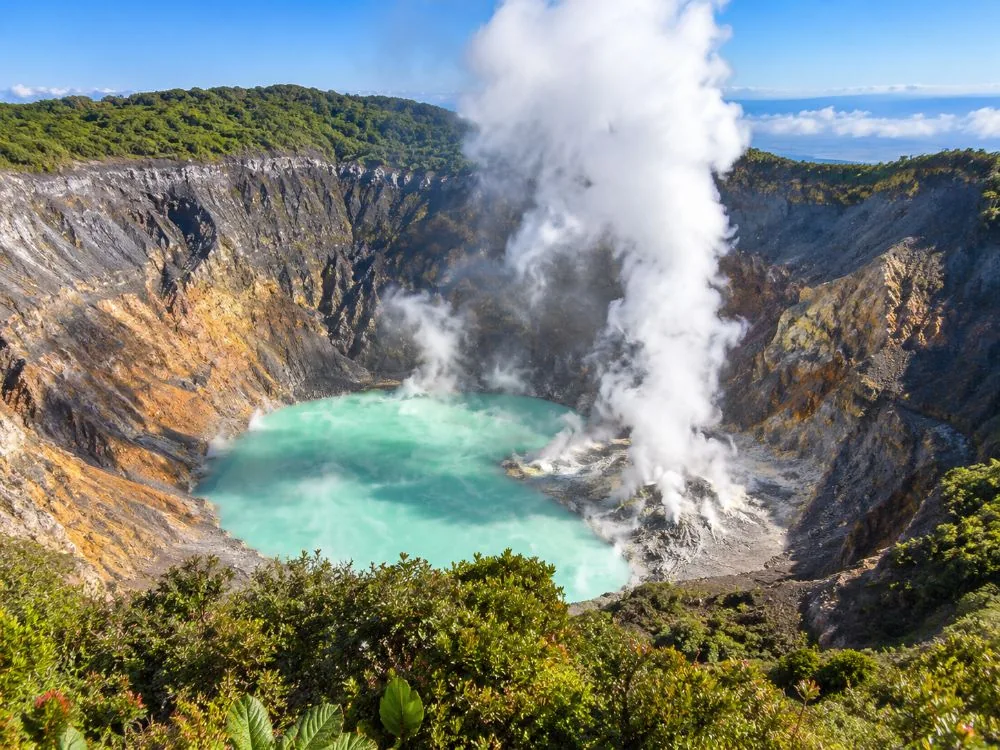
Poás is not dormant and is not about to become so. A quiet month means fewer explosions, not a sleeping volcano. For visitors, the activity is mostly a gas plume, the smell of sulphur and, if the cloud holds off, a lake that changes colour from grey to milky turquoise.
What type of volcano is Poás?
An active stratovolcano in Costa Rica's Cordillera Central, about 2,700 m high, with a crater 1.5 km wide and an acid lake that drives its steam blasts.
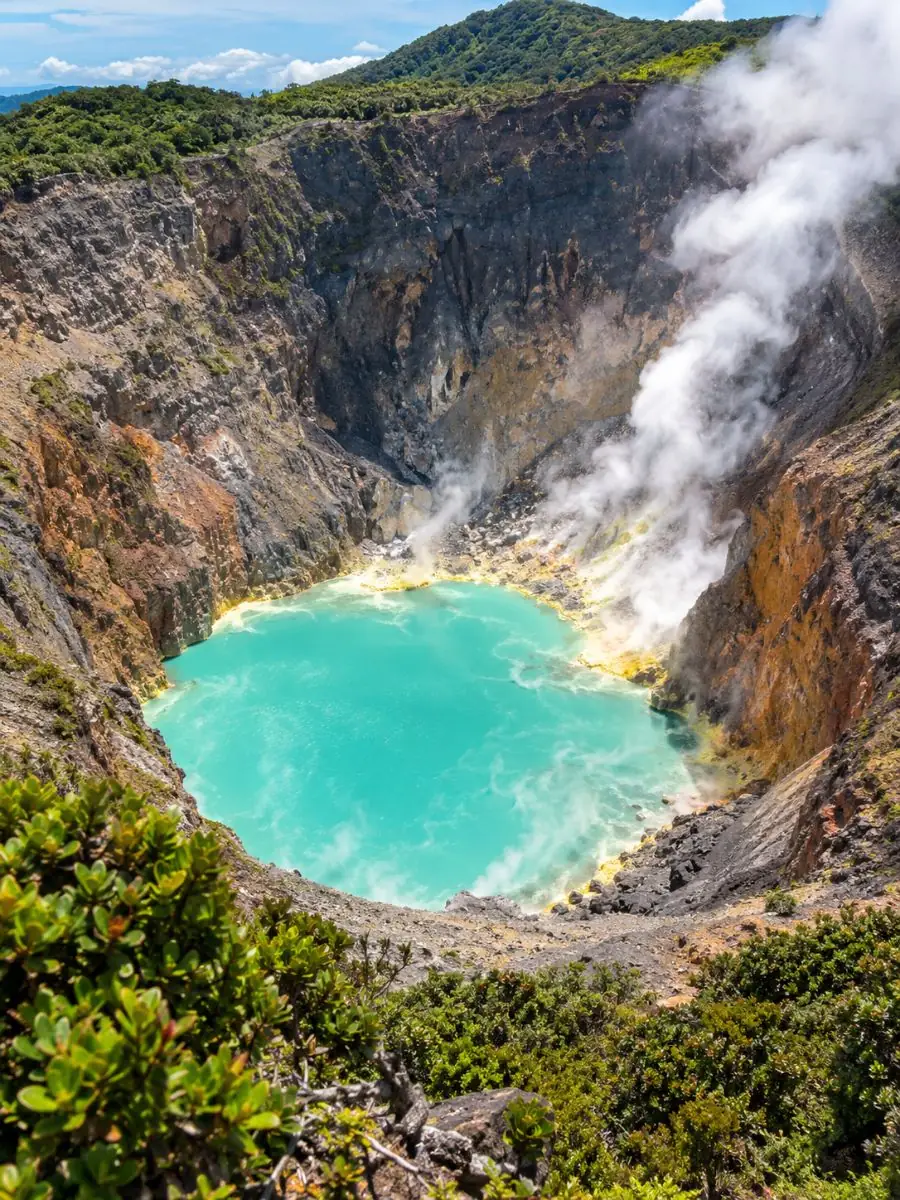
A stratovolcano is a cone built from layers of lava and ash over a very long time. Poás tops out at about 2,697 to 2,708 m (8,850 to 8,885 ft), depending on the survey. The main crater is about 1.5 km across and some 300 m deep (Wikipedia).
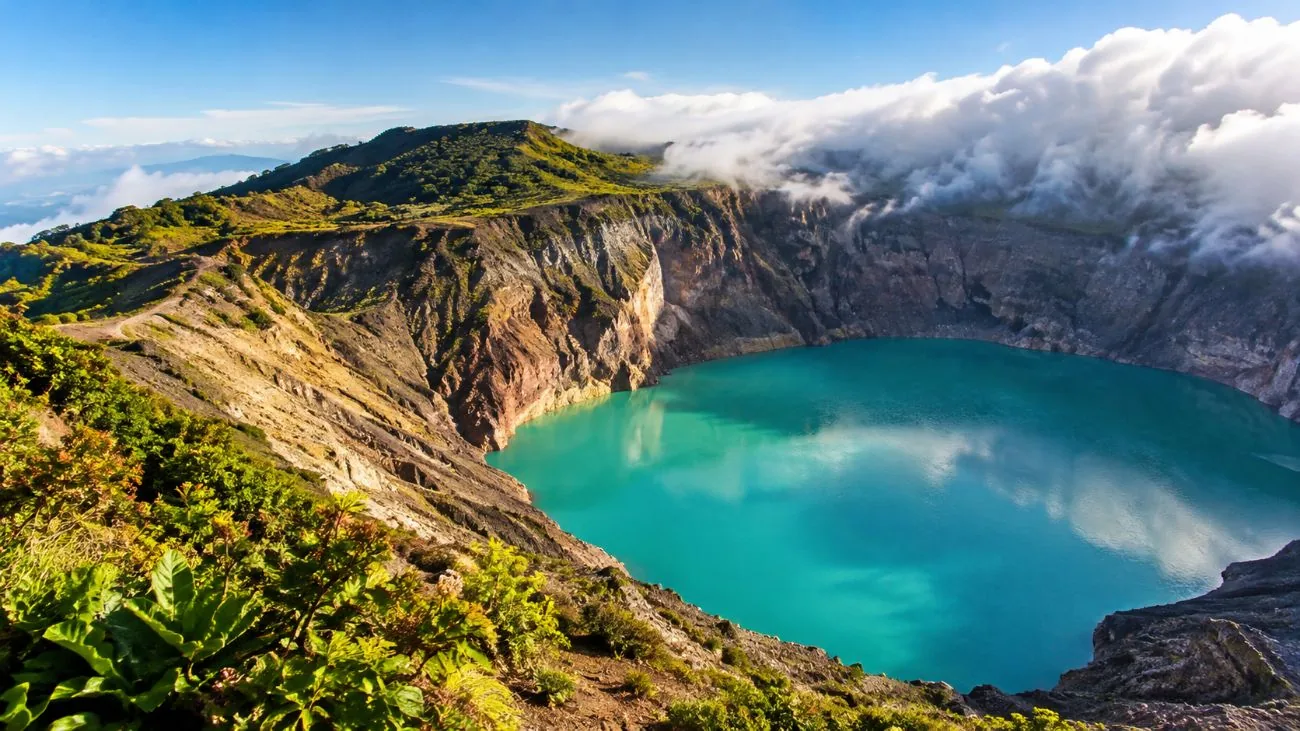
At the bottom sits Laguna Caliente, one of the most acidic lakes in the world, with a pH sometimes near 0 and liquid sulphur on its floor. Most Poás eruptions are phreatic: lake and ground water hit hot rock and flash to steam. Sometimes fresh magma is involved too, and those are the stronger blasts. Cold, green Laguna Botos, in an older crater to the south, has been quiet for thousands of years.
How often does Poás Volcano erupt?
About 40 recorded eruptions since 1828, counted as episodes. Recently the rhythm has been small eruptions every few days or weeks, broken by quiet months.
The count of about 40 treats a whole eruptive period as one entry. Inside an active phase, OVSICORI can log several small eruptions in a day. In March 2024, for example, two explosive eruptions were followed by continuous ash emission as the lake nearly dried out, while the volcano stayed at level 2 (Prensa Latina, April 2024).
The big phases are rarer. The 1953 to 1956 cycle built a lava dome. The April 2017 eruptions destroyed that dome, dried the lake and closed the park for about 17 months, until 1 September 2018. The 2025 phase was the strongest since 2017.
| Period | What happened | Park |
|---|---|---|
| 1828 onward | About 40 recorded eruptions | n/a |
| 17 May 1953 to 1956 | Long eruptive cycle, lava dome built | Before the park (1971) |
| April 2017 | Dome destroyed, ash column over 3 km, lake dried | Closed about 17 months |
| February and September 2019 | Ash eruptions, 2 km column on 30 September | Limited access since 2018 |
| March 2024 onward | Explosive eruptions, then near-continuous small ones | Open, limits on and off |
| March to July 2025 | Strongest phase since 2017, ash over 4 km | Closed 26 March to 30 July |
| 2026 | Eruptions in April, July and 27 August | Open, limits since 28 August |
What happened during the 2025 eruptive phase?
Rising eruptions from February, a closure on 26 March, ash above 4 km on 21 and 23 April and a red alert, then a slow calm-down and a reopening on 30 July 2025.
The year started with frequent small blasts. On 1 March 2025 an eruption threw material more than 200 m (CRHoy). On 7 March OVSICORI raised Poás to level 3, Precaución (Delfino). The park reopened briefly on 11 March with a 56-person limit and helmets, then closed "preventivo e indefinido" on 26 March under a yellow alert (Delfino).
On 21 April an ash column rose about 4 km, the tallest since 2017, and the blasts repeated on 23 April. That afternoon the CNE put the park on red alert (Teletica). The last big explosive event came on 19 May. Alerts were stepped down, to green by 2 July, and the park reopened on 30 July 2025 (Delfino). Small eruptions went on after that, such as a 300 m plume on 9 September 2025.
| Date (2025) | Event |
|---|---|
| 1 March | Eruption throws material over 200 m |
| 7 March | OVSICORI raises Poás to level 3, Precaución |
| 11 March | Park reopens with 56-person limit and helmets |
| 26 March | Park closes indefinitely; CNE yellow alert |
| 21 and 23 April | Ash columns above 4 km; red alert for the park on 23 April |
| 19 May | Last major explosive event of the phase |
| 2 July | Alert lowered to green |
| 30 July | Park reopens to visitors |
The private tour aims for the first entry of the day, before the cloud and the crowd.
Check dates for the private Poás tourHas Poás erupted in 2026?
Yes. OVSICORI reported continuing eruptions in February, eruptions in March and on 27 and 28 April, small ones on 4 and 24 July, and a stronger one on 27 August.
The infobox on Wikipedia cites an OVSICORI update of 24 February 2026 titled "Continuing eruption". A 4 July eruption was compared with one in March, which means Poás erupted that month too (CRHoy). In between came the odd one: on 10 April part of the crater wall collapsed into the lake, lifting it about 3 m.
The 27 August eruption, at about 2:36 a.m., threw hot rock about 600 m. That is what changed the visit: half the daily visitors, helmets and 20-minute turns at the rail. On 9 October a tall plume turned out to be degassing, not an eruption. For the rules and the park's state today, see is Poás Volcano open?

Two to four people in an electric car, an early start for the best chance of a clear crater, and Katy's strawberries on the way down.
Explore the private Poás tour Tour detailsWhat do OVSICORI levels and CNE alerts mean?
OVSICORI rates the volcano's activity from 1 to 4. The CNE issues colour alerts, green to red, for the park and nearby towns. They are separate scales.
OVSICORI is the scientists. Its four levels describe what the volcano is doing: level 2, Advertencia, is where Poás has sat for most of 2026, with possible light ash, acid rain, gas and rocks thrown close to the vent. Level 3, Precaución, means the volcano "puede manifestar erupciones, emisiones de lava o ceniza" (Delfino, March 2025). Level 4 is the top step.
The CNE is civil protection. Its green, yellow, orange and red alerts tell towns and the park how to prepare. They follow current activity, not a forecast. In April 2025 the CNE's Walter Fonseca said the red alert "no se trata de un pronóstico sobre una gran erupción inminente", it was not a forecast of a big eruption on the way (La Nación).
| Scale | Level | Poás example |
|---|---|---|
| OVSICORI | 2, Advertencia | Most of 2024 to 2026 |
| OVSICORI | 3, Precaución | From 7 March 2025 |
| CNE | Green | 6 May 2026 and 28 August 2026, park open |
| CNE | Yellow | 26 March 2025, park closed |
| CNE | Red | 23 April 2025, park closed |
Frequently asked questions
Did Poás Volcano last erupt in 2017?
No. 2017 was a big eruption, but Poás erupted again in 2019, through 2024 and 2025, and several times in 2026, most recently a stronger eruption on 27 August 2026.
Is there lava at Poás Volcano?
No flowing lava. Poás throws out steam, gas, ash, mud and rock in phreatic eruptions. In 2025 the crater glowed at night because magma sat a few metres below the vent.
Can you see an eruption from the Poás viewpoint?
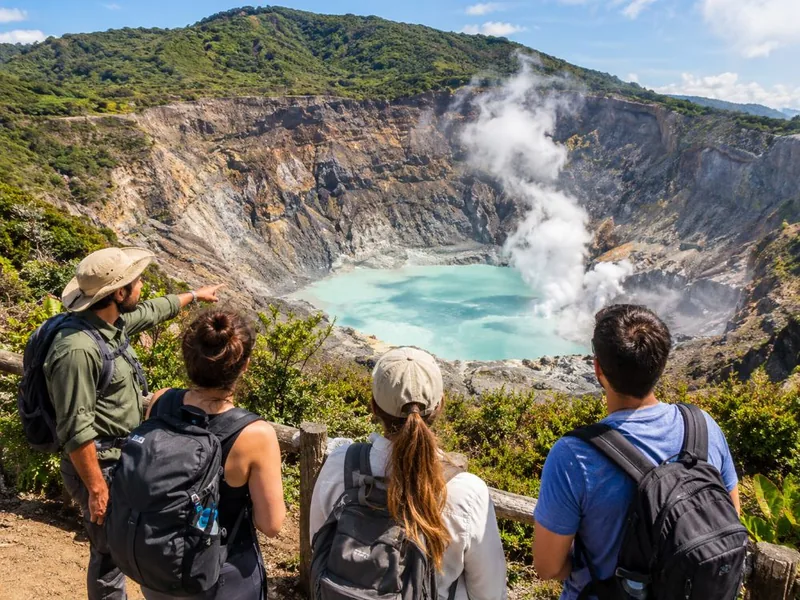
Small eruptions and gas plumes can happen during a visit, and the rules exist for that reason. Most visitors see a steaming lake, or cloud. Nobody can promise either.
Is it safe to visit Poás Volcano?
The park opens only when SINAC, OVSICORI and the CNE agree the risk is acceptable, with limits such as helmets and 20-minute turns. Follow the rangers and stay on the open trails.
Ready to book
Choose your tour
Free cancellation up to 24 hours before on most options. Prices are from-prices in USD and move with the season.
Private Poás Volcano & La Paz Waterfall
- Private guide and electric vehicle, 2 to 4 people
- Hotel pickup within the Central Valley (GAM)
- Park entrance and parking fees
Poás Volcano, Waterfall & Coffee Farm Day Trip
- Hotel pickup and drop-off in San José
- Live guide in English and Spanish
- Poás Volcano National Park entry fee
Poás Volcano, Coffee Plantation & La Paz Waterfall Gardens
The full gardens with a buffet lunch, not just a roadside look